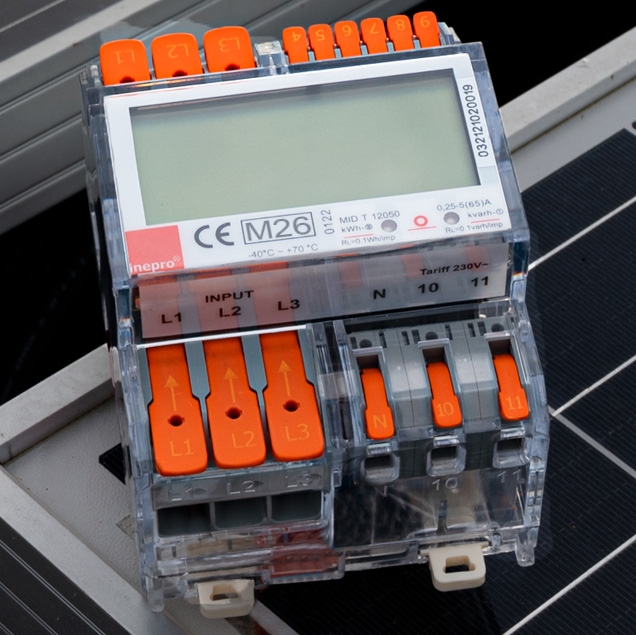
In this new energy landscape, the meter's role is shifting from static data registration to dynamic grid control, with energy meters serving as smart, vital sensors designed for today’s energy systems.
Smart metering to prevent overloads
As energy systems become more dynamic, managing electrical loads has become essential. Solar power output can change within seconds as clouds pass; heat pumps and industrial equipment can cause sudden fluctuations, and fast chargers for electric vehicles can draw a lot of power almost instantly. These sudden spikes can exceed the grid’s transmission capacity, causing a structural overload. And in an overly congested power grid, every peak is an issue.
Load balancing ensures electrical devices never draw more power than a connection can handle, and the energy meter plays a crucial role by continuously measuring current consumption and transmitting this data as quickly as possible to, for example, a charging station or an energy management system. Based on this data, charging power adjusts automatically to prevent spikes and keep the system operating safely. A fast, accurate & precise response is key here. The meter lets systems scale back when consumption suddenly rises.
Correct peak calculations to manage costs
Peak demand is the highest level of electricity consumption during a given period and is becoming more important in energy costs for the grid connection. As facilities such as data centres, factories, electric vehicle charging stations, heat pump installations, and renewable energy systems grow in size and complexity, accurate peak-demand monitoring and management have become essential. In many countries, grid connection tariffs are an important factor determined directly by peak consumption.
Peak demand is unforgiving: every spike counts. Since peaks often occur on a single phase, the meter must record data per phase to avoid errors. And without a continuous data stream with exact timestamps, peak calculations become unreliable.
Power quality as an indicator of a stable power grid
Modern electrical installations have transformed the electricity grid from a predictable, unidirectional system into a more dynamic and decentralised environment. Inverter-powered devices are increasingly common, such as charging stations, solar panels, heat pumps, data centres, and AI servers. At high penetration levels, and depending on equipment design, control strategy, network strength and phase allocation, these installations can contribute to rapid load variations, voltage deviations and flicker, harmonic distortion, and phase imbalance. At the same time, growing and increasingly concentrated electricity demand can create local congestion and overload network components. These developments make power-quality monitoring and active grid management increasingly important.
The energy meter plays the leading role
Power quality, load balancing, and peak demand are no longer niche topics. They now define whether a power grid is reliable, sustainable and ready for the future. At the heart of that transformation is the energy meter as the network's ‘eyes and ears’, monitoring quality, demand, and overloads.
The new PRO1, PRO2, and PRO3 energy meters are designed for today's energy landscape, offering exceptional accuracy and rapid data collection to capture even the briefest events. With Class C accuracy of ±0.5% and full compliance with the latest MID standards, the PRO-line sets a new benchmark for reliable, efficient and future-proof installations. Within just 75 milliseconds, the PRO meters provide insight into consumption, feed-in, voltage and grid quality; and by supplying accurate voltage and frequency data, the PRO range also supports smart charging and future Vehicle-to-Grid applications.
The PRO line gives you the insight needed to optimise performance, maintain stability, ensure compliance and confidently manage today’s and tomorrow’s increasingly complex electrical environments.
For more information about the new PRO1, PRO2 and PRO3, please visit: The new PRO-line energy meters for smarter grid management.