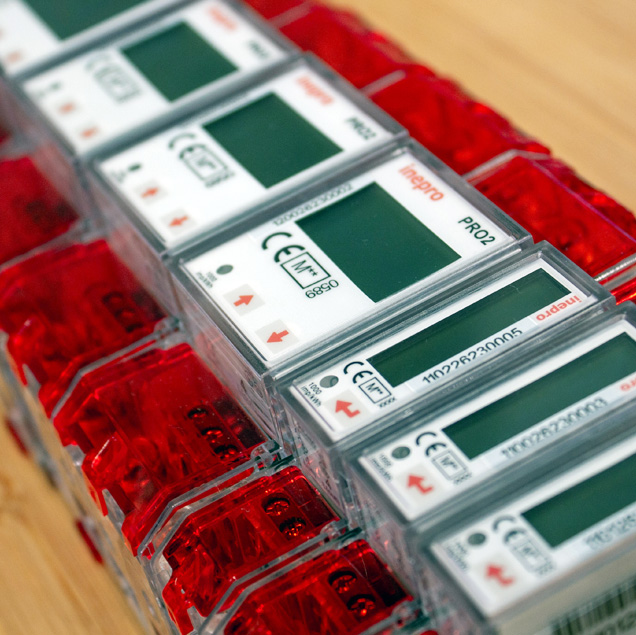
For more than two decades, the European Measuring Instruments Directive (MID) has formed the foundation of legal metrology. This Directive ensures that all European measuring instruments used for billing purposes deliver accurate, reliable and consistent results. Rapid technological developments and changes to EU product legislation have led to an update, adopted on 11 March this year. By setting out clearer responsibilities for manufacturers, importers and distributors, market surveillance will be strengthened, ensuring the legislation keeps pace with new technologies and future innovations.
What is the Measuring Instruments Directive?
The Measuring Instruments Directive (MID) sets out the rules for the design, testing and approval of measuring instruments, such as electricity meters, water meters, gas meters, taximeters and weighing systems, before these products can be sold in the EU. Under the new MID, an EV charger is also regarded as a measuring instrument. As soon as a charger measures energy for billing, invoicing or ERE registration, the entire charging point, including the integrated MID meter, is subject to the same legal requirements as ‘traditional’ electricity meters.
Among other things, the MID specifies that measurements must remain within defined accuracy margins. The same measurements must also consistently produce the same result and detect small variations. In addition, performance characteristics must remain reliable for more than 8 to 10 years, measurement results must not be subject to unauthorised manipulation, and the meter must display the measured value clearly and verifiably. For electricity meters, and now also for charging stations, MID certification means the kWh measurement is legally valid, the meter/EV charger has been independently tested, and the measurement is reliable enough for billing, cost allocation, or CO₂ certificates (EREs).
Electricity meters ready for dynamic electrical environments
The amendment to the Measuring Instruments Directive was adopted last March, and all Member States are now implementing it into national legislation. A transition period is currently in force and, once it ends, electricity meters or EV chargers may no longer be manufactured under the old MID. Manufacturers will therefore need to upgrade their products to meet the new requirements, ensuring they are ready for modern, non-linear, bidirectional and highly dynamic electrical environments.
The electricity grid is no longer a simple, stable, unidirectional system. Electric vehicle charging points, solar power inverters, LED lighting and heat pumps cause distorted waveforms, rapid load changes and reverse current flows. EN 50470-3:2022 aligns measurements with the modern electricity grid. Whereas EN 50470-1/3: 2006 meters were previously tested under ideal laboratory conditions, the new EN 50470‑3:2022 introduces disturbance-based tests that reflect current installations, including harmonic interference up to the 50th order, rapid load fluctuations and cold starts at –25 °C for outdoor and mobility applications.
The accuracy requirements have been tightened to guarantee correct measurements at low currents and with distorted waveforms. EN 50470-3:2022 stipulates that measuring instruments must maintain their accuracy even at these low currents.
In addition, the standard provides full bidirectional measurement for smart grid applications, ensuring accurate measurement of incoming and outgoing energy for solar energy, V2G, and microgrid applications. Safety and tamper-resistance requirements have been enhanced through improved insulation, magnetic field resistance and more robust mechanical protection, making the meters more resilient and future-proof.
What does the amendment to the MID mean for the market?
For users and operators, the new MID regulations primarily ensure greater reliability on their billed energy, transparency and legal certainty. For users, this means they always have access to fully verifiable kWh measurements. The energy measured is accurately recorded and displayed transparently via a display, backend system or app. This prevents disputes over measurement errors and ensures fair, consistent tariffs, regardless of installation type or location.
For operators and manufacturers, the new MID provides a stable and legally secure foundation. The billed kWh readings are verifiably accurate, tamper-proof and comply with one harmonised European framework, resulting in a significant decline in complaints, legal risks and compliance costs. Maintenance is also simplified. Components such as cables, communication modules or housings can be replaced without invalidating the measurement chain, as long as the MID meter itself remains intact. This extends installation lifespans and reduces operating costs.
Lastly, the new MID creates a single European market. Manufacturers need to develop fewer product variants, operators can roll out systems more quickly, and systems become more interoperable. This will directly benefit both operators and end-users.
As inepro works closely with partners, notified bodies and government agencies, we keep up to date with the latest trends and developments. Our new PRO meters, which will be launched soon, will comply with the new MID standard. For more information, please click here: The new PRO-line energy meters for smarter grid management.
Under the revised MID standard, EV chargers are now also classified as financial measuring instruments. Errors can lead to immediate financial loss or legal risks. Do you want to prevent this? Click here for our Tunkia EV charger testing solutions: Tunkia EV charger testing solutions.