Local authorities and policymakers see V2G as a way to reduce grid congestion and accelerate the energy transition, while energy companies mainly emphasise the benefits for grid balancing and more efficient use of renewable energy. At the same time, the public remains cautious due to concerns about battery wear and practical feasibility. Furthermore, not all electric cars and charging stations are already equipped for bidirectional charging, and regulations and standards are still under development. In this blog, we explain what V2G is, what benefits it offers, and why the bidirectional electricity meter plays a key role.
What is V2G?
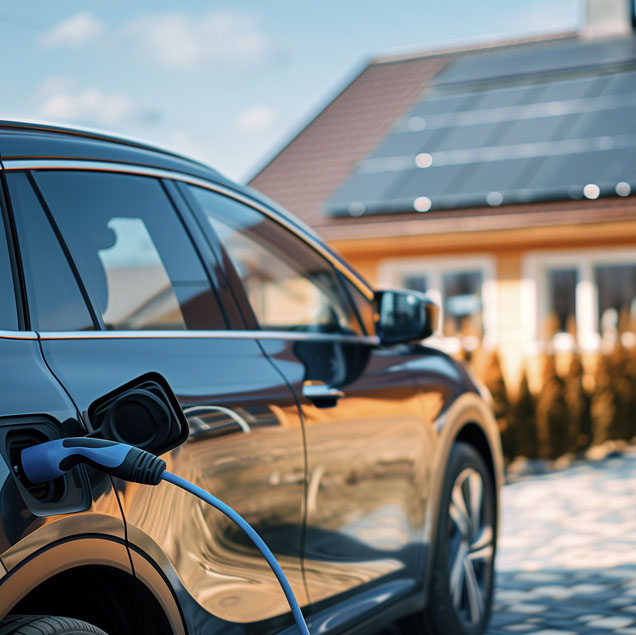
Vehicle-to-Grid (V2G) is a technology that allows EVs (electric vehicles) to not only draw power but also feed it back into the grid. This turns a car into a flexible battery that can store and release energy when needed.
Due to rising electricity demand, the grid is becoming increasingly congested. V2G can help better balance supply and demand. For example, an EV can be charged when there is a lot of (and often cheaper) energy available, and the same car can feed stored energy back into the grid when demand is high. Through this continuous interaction, V2G supports the electricity grid and reduces peak loads.
In addition to V2G, there are also the following variants:
- V2H (Vehicle-to-Home): the car supplies power to the household.
- V2X (Vehicle-to-Everything): broader applications such as appliances.
What do you need for V2G?
Successful implementation of Vehicle-to-Grid requires more than just an electric car. A complete V2G system requires:
- An EV that supports V2G;
- A bidirectional charging station;
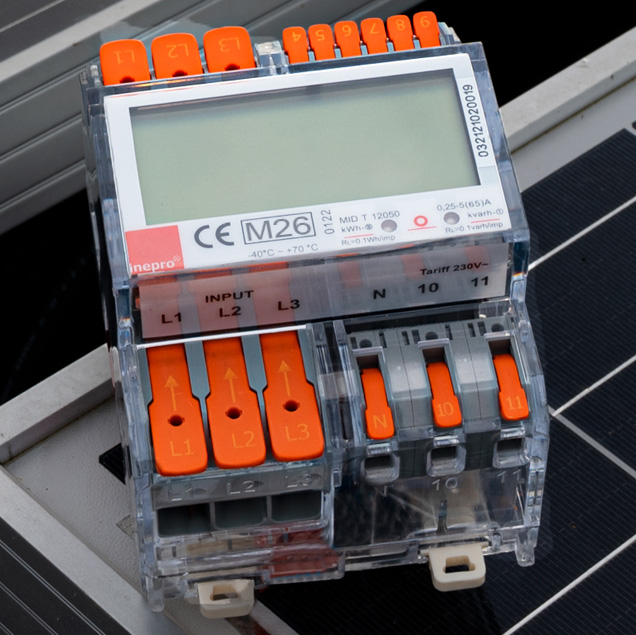
- A MID-certified bidirectional electricity meter that registers both charging and discharging;
- Energy management systems that intelligently control charging and discharging;
- Energy companies and grid operators that make V2G technically and contractually possible;
- Tariff structures that respond flexibly to supply and demand;
- Clear regulations and standards that facilitate the use of V2G.
What are the benefits of V2G?
V2G transforms electric cars from passive consumers into active energy partners. It offers both economic benefits for drivers and system benefits for the community.
Benefits:
- The EV can be charged during off-peak hours (when electricity is cheap) and feed back into the grid during peak hours (when electricity is more expensive). This results in savings on the energy bill and sometimes even direct income.
- EVs can act as flexible energy storage. They can absorb peaks in supply and demand. This helps reduce grid congestion and improve system reliability.
- V2G enables temporarily storing surplus green electricity in EVs and feeding it back later. This makes more efficient use of renewable energy.
- Using millions of EVs as mini batteries will make the transition to a Carbon-neutral energy system faster and cheaper.
- V2G enables local energy sharing, for example, within a neighbourhood or a company. This promotes energy autonomy and can lead to lower infrastructure costs.
V2G therefore has all the potential to be a key technology for a stable, sustainable, and affordable energy system of the future.
The crucial role of the bidirectional electricity meter in V2G
Without an electricity meter, V2G is practically impossible, because no one knows how much energy is going where and who should be paid for what. For V2G, it is essential to accurately monitor both the power consumed by the EV and the amount it feeds back into the grid. A standard meter only ‘looks’ in one direction, while a bidirectional meter measures what is drawn from the grid and what is fed back, for example, via an EV or solar panels. Whereas a one-way meter can only count how much you consume (import), a bidirectional version accurately records imports and exports separately.
A MID-certified, bidirectional electricity meter is an essential foundation for V2G applications. It accurately records how much power an EV draws from the grid and how much it feeds back, preventing billing errors and providing complete transparency. Because only MID-certified meters are legally valid for billing, their metering data serves as the basis for financial transactions among grid operators, energy suppliers, and EV owners, including payments for energy fed back into the grid. These meters are also often integrated into smart charging stations and energy management systems, enabling dynamic tariffs and smart charging. This creates a reliable, verifiable foundation that strengthens trust among all parties and enables V2G at scale.
A scenario: Charging at work, discharging at home
A scenario that is expected to occur frequently with V2G will involve business EVs. For employers and employees to handle costs and reimbursements correctly, charging at work and discharging at home for private use requires clarity. This raises legal, tax, and technical questions that can be made transparent and manageable through MID electricity meters and linked administrations.
An example of a V2G scenario is an employee charging their electric car at the employer's business connection and then feeding that same energy back into their own household. This effectively means that business electricity is being used privately, which is considered a benefit-in-kind for tax purposes. The electricity meter, often in conjunction with a smart charging station, makes this distinction clear by recording exactly how many kWh are charged at work and how many are discharged at home.
By linking this data, it is possible to determine the proportion of business energy used privately, so that the employer and employee can settle this correctly. Employers can draw up policies and settlement models for this, ranging from passing on the costs to the employee to treating it as a secondary employment condition. Thanks to accurate registration and administration, both the tax settlement and the technical check remain clear and workable.
V2G makes an EV more than just a means of transport: it becomes a flexible energy source that can reduce costs, generate income, and enable us to operate more sustainably. By making smart use of bidirectional charging, peaks can be smoothed out, solar energy can be used optimally, and grid reinforcement can be reduced. At the same time, modern systems are more effective at preventing battery wear than is often thought. V2G, therefore, seems to be a logical next step in both energy management and sustainability.
Looking for a bidirectional electricity meter for V2G? Please check out our PRO meters or Ambition series.